During my 3rd and 4th year at University, whilst home for the summer, I got a summer internship under Professor Roger Whatmore in the Nanotechnology Department at Cranfield University. That summer I worked on a new measurement technique for a class of functional materials called piezoelectrics. I had no idea that in a few years I'd be back, running X-ray crystallography machines, using scanning & tunnelling electron microscopes, in the lab depositing thin films via chemical vapour deposition and sputtering, in the clean room with sol-gels preparing photolithographic masks, and in the computer lab building 1D and 3D models, designing masks and many other activities.
This article summarises some of the academic research I was able to publish; this is only a small snapshot of the work conducted. Looking back, I'm eternally grateful for those that supported me and showed me the ropes: Roger Whatmore (my prof), Steve Wilson (my mentor), Andy (the technician), Rob Dorey (the incoming postgrad who now runs the shop), Eiju Komuro, Masaaki Imura, Taku Takeishi, Qi Zhang and others (TDK researchers), Heather Almond (who taught me lapping & polishing) and many others.
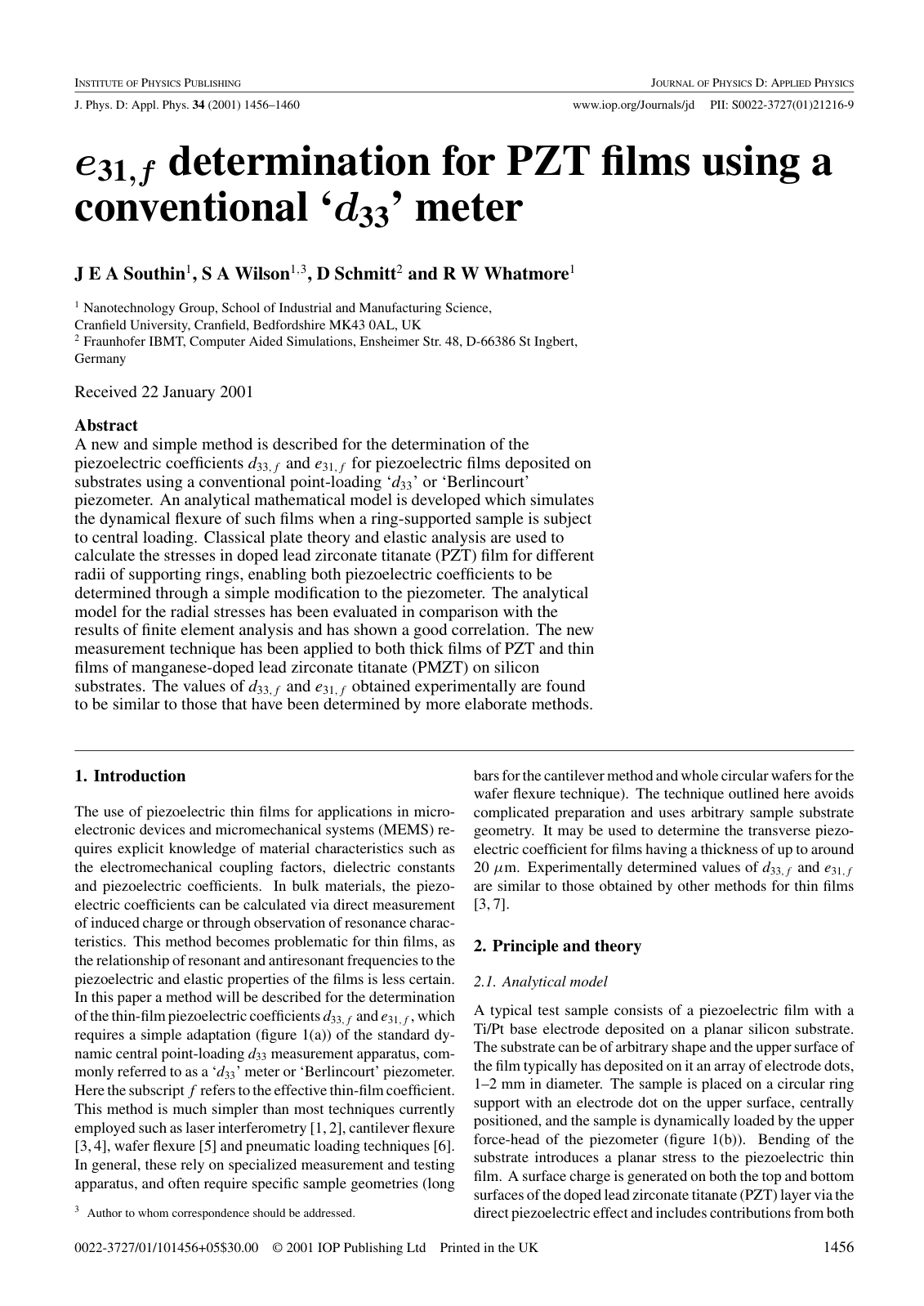
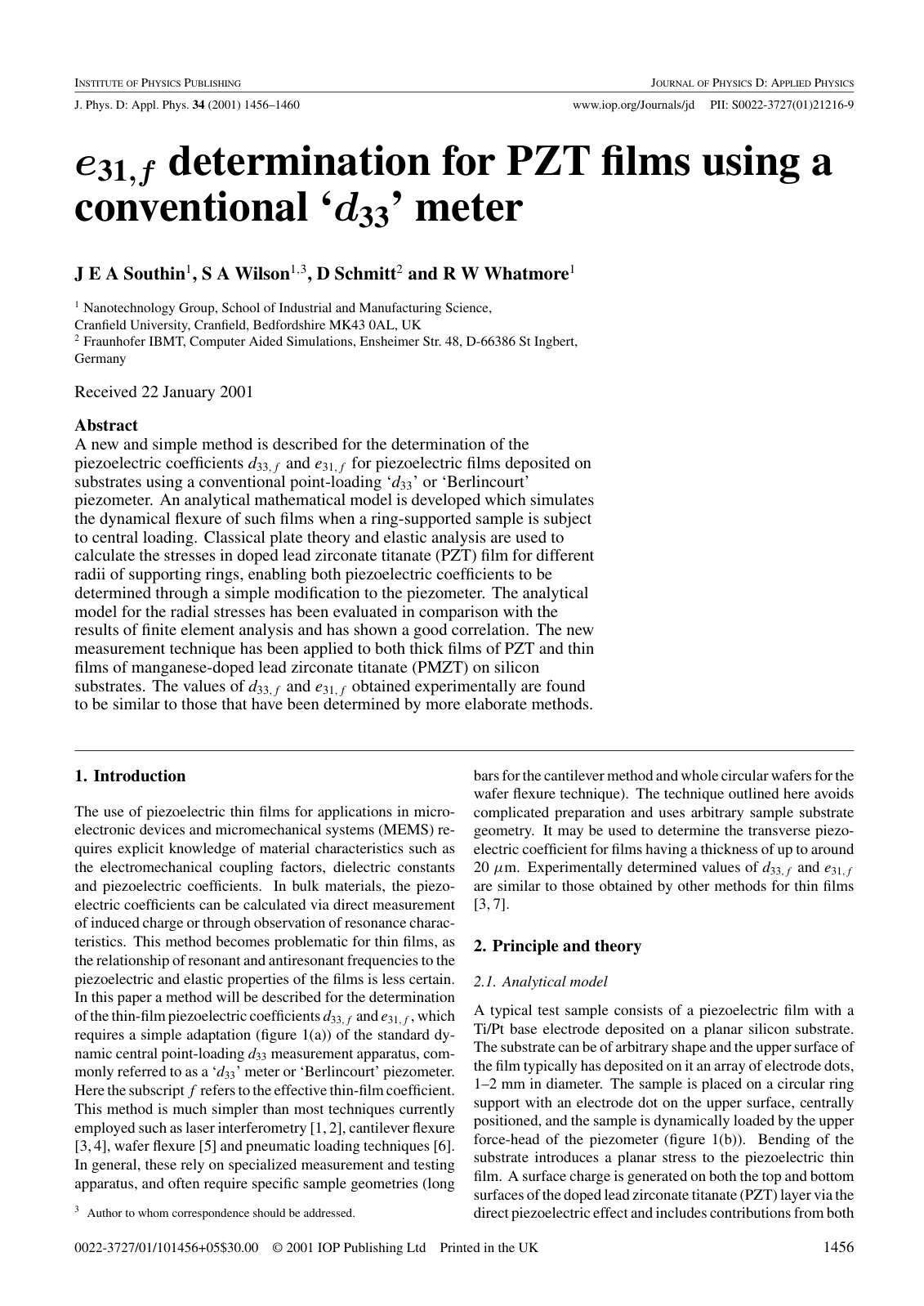
e31,f determination for PZT films using a conventional 'd33' meter
This paper was the culmination of the 3-month project. It involved manufacturing new measuring devices, a lot of reading from canonical sources, and finite-element modelling provided by Daniel Schmitt (a colleague in Germany). This paper has since been cited 66 times — with a Field-Weighted Citation Impact of 8.83 (97.9th percentile — top ~2% of papers from that year). A proud moment to be published in the Journal of Physics.
Open PDF →After I completed my Masters, I returned to the same lab as a Research Scientist, continuing where I left off, and working on film-bulk-acoustic-resonators. These are tiny filter devices that you'll find in mobile phones, and allow the receivers to zero in on a specific frequency band. These ones were ~2.4 GHz. My work took me to several European conferences, presenting posters in the Royal Society in London, but most of the time was in the computer lab or the fabrication labs creating thousands upon thousands of samples. I became an expert in the modelling software ANSYS, AutoCAD for photolithographic mask designs, and even got use of the campus supercomputer: a 24-machine cluster called Beowulf, behind a RedHat OS-powered terminal. This felt a lot less exotic than it does in the films — a dusty console in the corner of a room, command-line access only; loading a file for processing, setting it running, and coming back 72 hours later to get the results: a static scalar value for the electro-mechanical coupling factor, with a number like 2.32. Apparently on the same campus they had an old Cray-2, but I never saw it.
This work eventually turned into a Ph.D, sponsored by TDK, who had several research scientists embedded in the lab. The paper below was one of the ones that resulted.
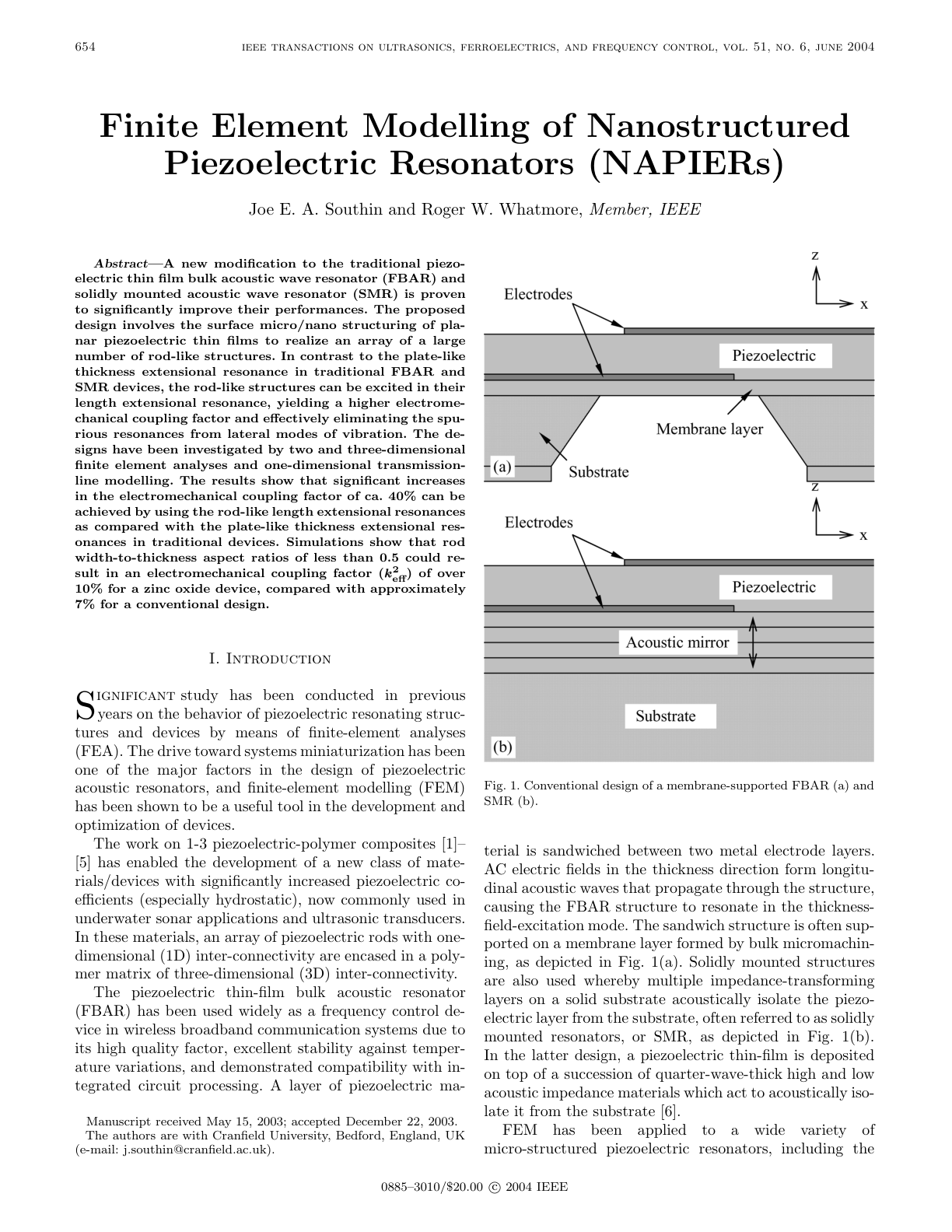
Finite Element Modelling of Nanostructured Piezoelectric Resonators (NAPIERs)
This paper was my first first-author paper, and in one of the many excellent IEEE journals. There was so much research that never made it in here; I particularly enjoyed the 1D-transmission-line modelling (modelling layers in a material like components in an electrical circuit), and a lot of work we did on asymmetric electrode-plate shapes to limit unwanted resonances that never really worked. This paper only got 15 citations (75th percentile for its publication year), but I'm really satisfied with the results.
Open PDF →Alongside the above work, I also got named on a US patent, into which I contributed nothing other than the source research.
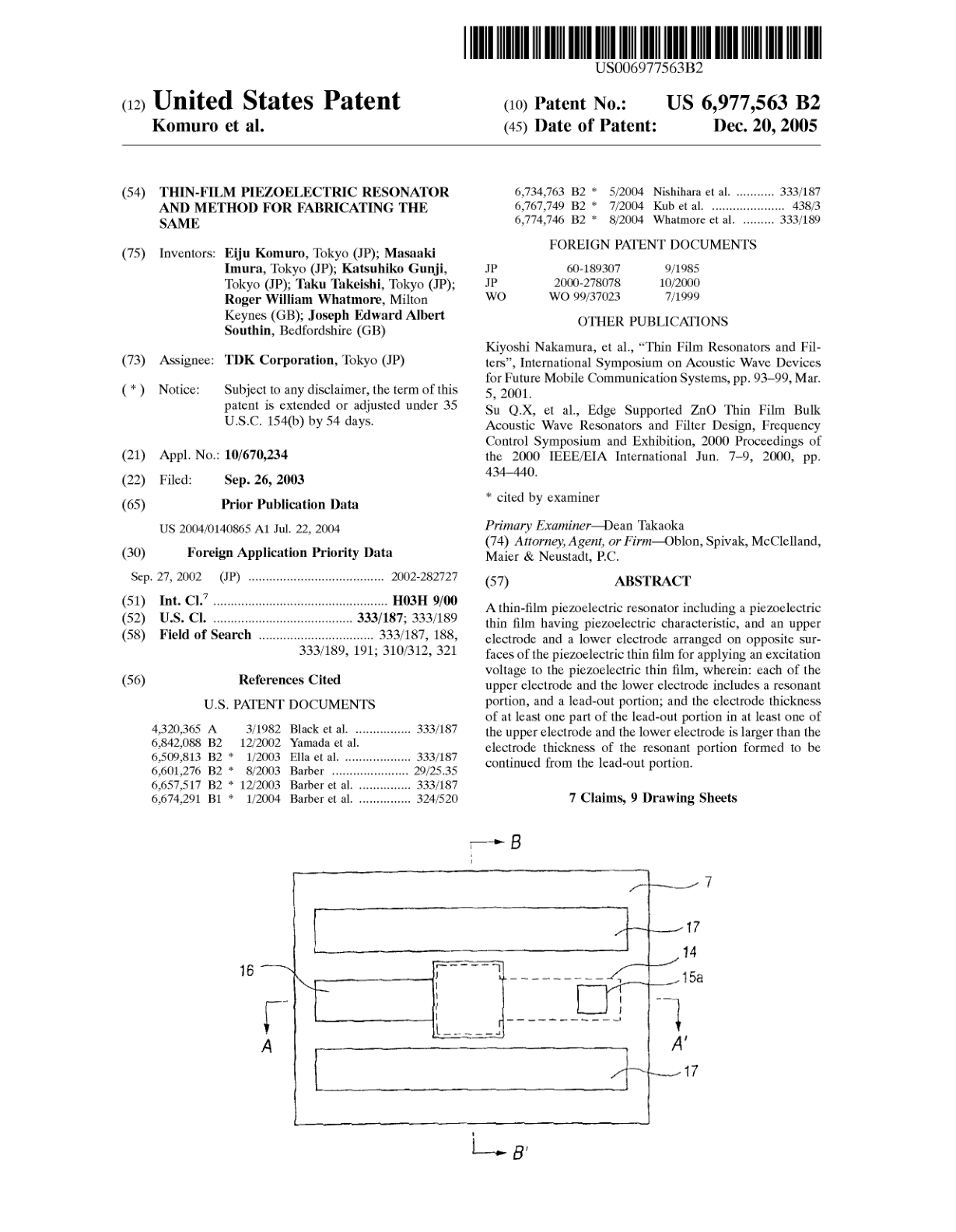
THIN-FILM PIEZOELECTRIC RESONATOR AND METHOD FOR FABRICATING THE SAME
I find the language on patents like this nearly incomprehensible!
Open PDF →I also found my first ever mention in the journals in the paper below. Interesting story here. When I was around 8–9 years old, I used to watch the BBC programme Tomorrow's World. I distinctly remember watching an article about inverted pendulums, and decided to write in a letter, to which I got a response (I've still got the letter somewhere in the loft). Almost 15 years later, I find myself choosing projects to do in Manchester for my undergrad, and selected one on non-linear physics with a Professor Tom Mullin. Turns out this was the same person I wrote to all those years ago. With my trusty lab partner Greg Parkinson, we set out to investigate the parameter spaces where a piece of inverted curtain wire could be forced to stand on end by a small motor (parametric excitations). We wrote a program (I think in C, or C++), that we hooked up to a basic laser that could track the passing of the pendulums over long periods of time. The work below is not my write-up, but we are mentioned briefly.
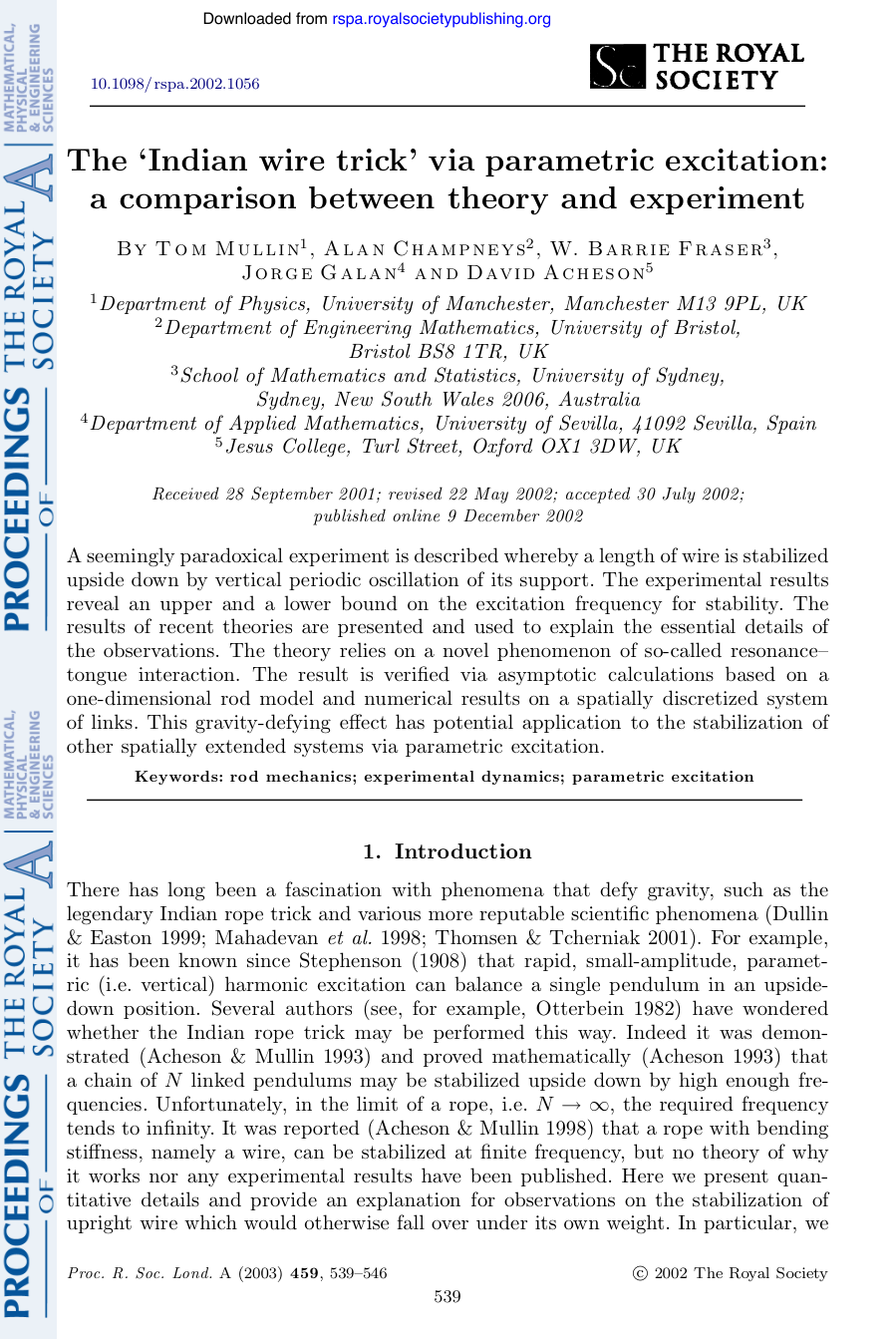
The 'Indian wire trick' via parametric excitation: a comparison between theory and experiment
A seemingly paradoxical experiment is described whereby a length of wire is stabilized upside down by vertical periodic oscillation of its support. The experimental results reveal an upper and a lower bound on the excitation frequency for stability.
Open PDF →There were also a couple of papers I've not managed to track down. Both were conference proceedings that were never digitised or made widely available online. This is unfortunately common for specialised European conference proceedings from that era.
Paper 1: "Finite element modelling of FBAR structures" (POLECER 2004)
- The POLECER 2004 conference (International Conference on Material Technology and Design of Integrated Piezoelectric Devices) was held Feb 2–4, 2004 in Courmayeur, Italy, as part of the EU FP5 POLECER
Paper 2: "Design of spiral piezoelectric cantilever unimorphs for microactuation"
- Presented at EUSPEN '03 Congress, Aachen, Germany, 19–20 May 2003 by Southin, J.E.A., Wilson, S.A., Haigh, R.D., Dorey, R.A. & Whatmore, R.W.
Neither proceedings were published by a major publisher (no ISBN found, not indexed in Scopus/IEEE/Springer). They appear to have been distributed only to conference attendees.