I got lost down a fascinating rabbit hole trying to wrap my brains around fire, so decided to do some digging as I wasn't satisfied by my basic understanding. Here's the result of an evenings research in front of the fire...
1. “We all know what fire is”… except we kind of don’t
Stare at a flame and it feels obvious: fuel + oxygen + heat = fire. But from the flame’s point of view it’s a ridiculously complex physics and chemistry experiment compressed into a small volume of hot gas.
A flame is the thin region where hot gases, radicals, and reaction products mix and react exothermically (generating more energy than it takes to initiate the reaction). The glowing bit is just the part energetic enough to emit visible light.
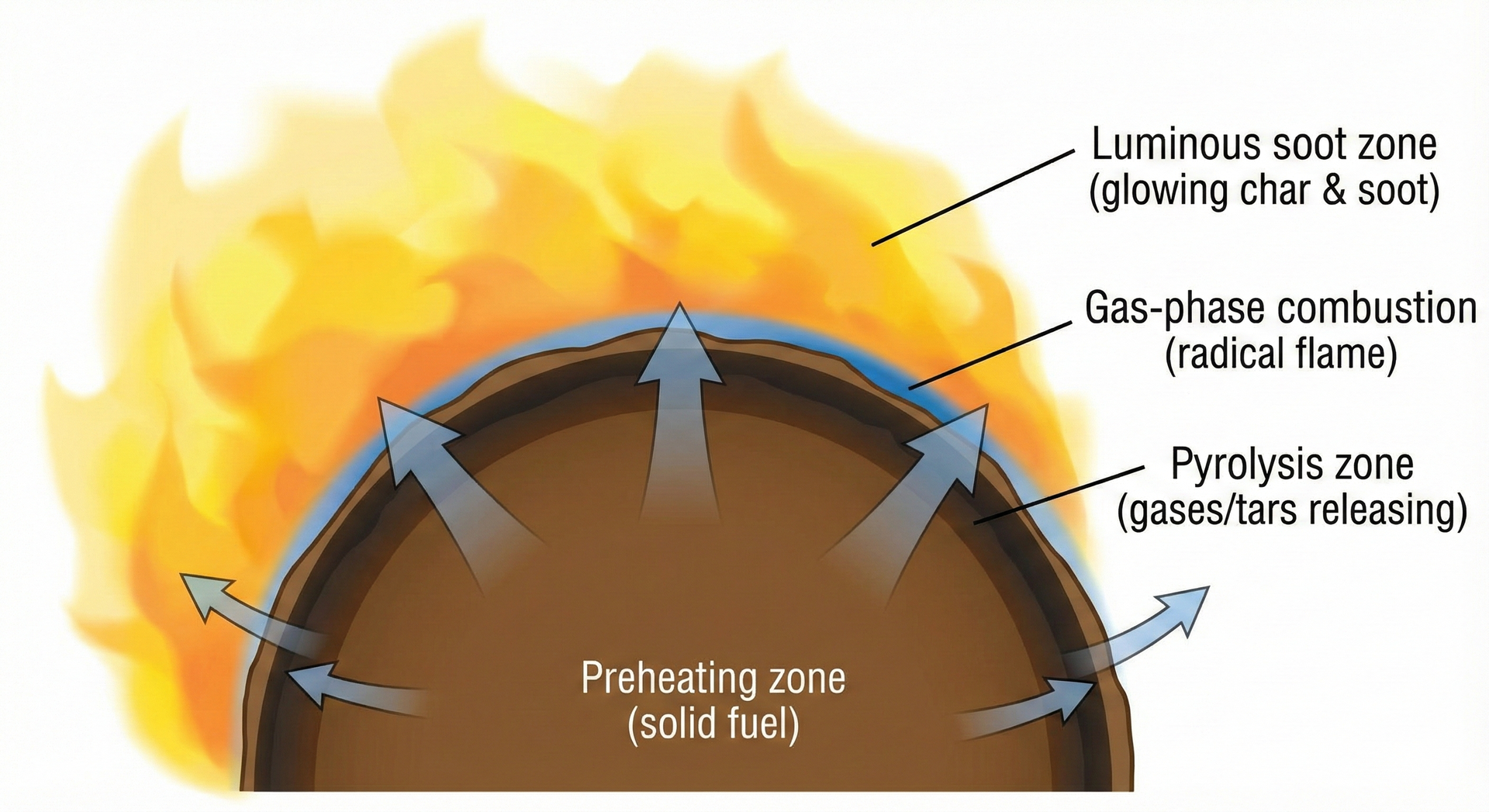
For a wood fire in air there are apparently three main stages:
- Preheating – Wood gets hot, water boils off.
- Pyrolysis – The solid wood breaks apart into gases and tars.
- Gas-phase combustion + glowing char – Those gases burn in the air above, while the leftover carbon-rich char slowly oxidizes on the surface.
Only step 3 is the “flame” you see. Steps 1–2 are happening invisibly in the solid fuel.
2. What’s actually burning when you burn wood?
“Wood” is mostly cellulose, hemicellulose, and lignin: long chains of Carbon (), Hydrogen (), and Oxygen () atoms. When it’s hot enough (but before it actually burns), those chains crack into:
- Light gases: , , , , , ,
- Tar vapours: a soup of heavier organics (containing things like aromatics, phenols, furans, etc.)
- Char: mostly carbon plus a bit of mineral ash
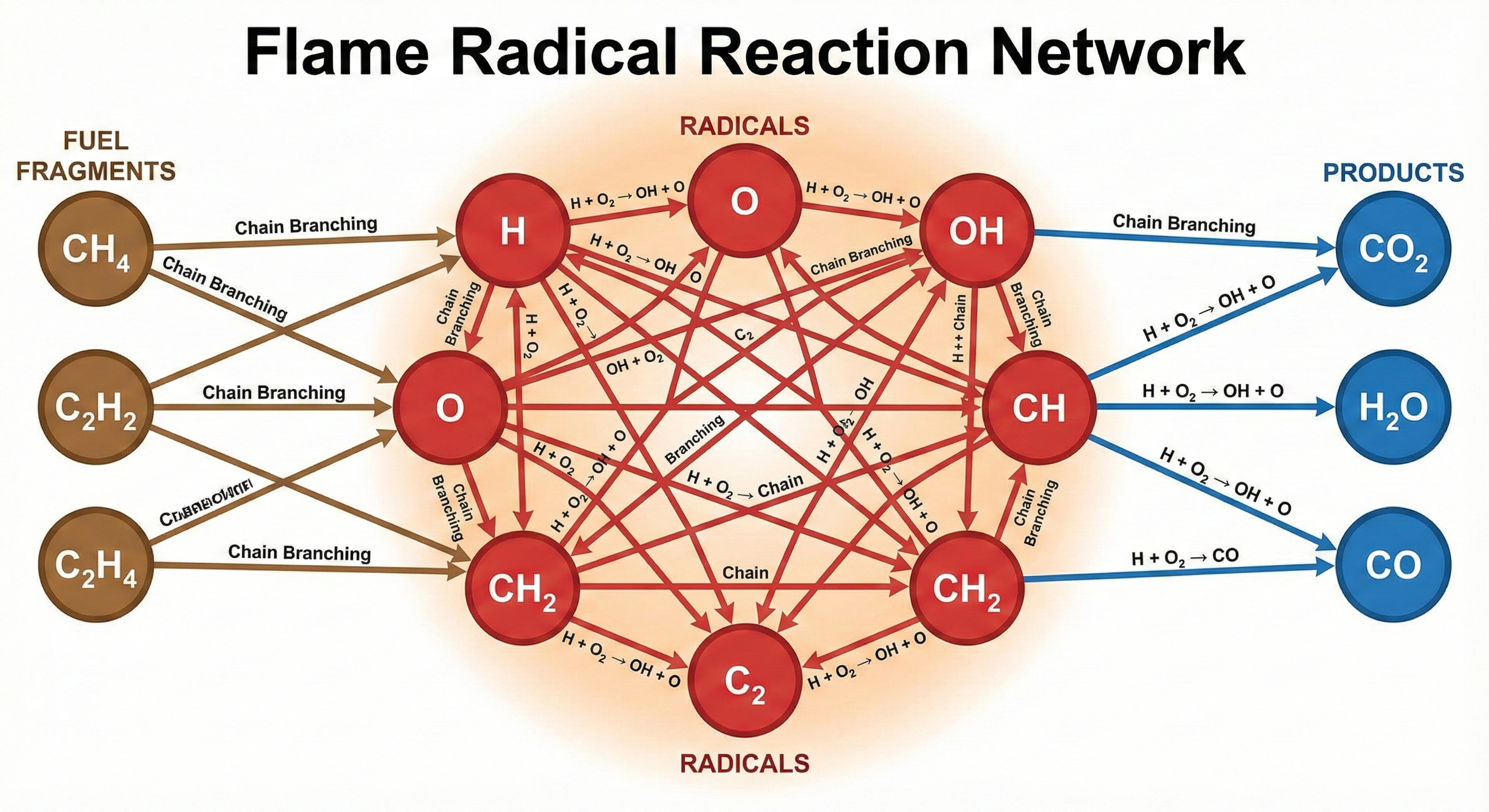
Those pyrolysis gases then mix with air (mostly , ~21% ) and go through a radical-driven chain reaction network. In the flame, you’ll find:
- Stable or semi-stable molecules: , , , , , , ,
- Radicals (highly reactive fragments with unpaired electrons):
- , ,
- ,
- , ,
- , ,
- various oxygenated radicals (, , etc.)
These radicals are what make combustion fast. Classic reactions like:
keep propagating chains of reactions, releasing heat that sustains the flame.
3. Blue vs yellow/orange flames: combustion quality in living colour
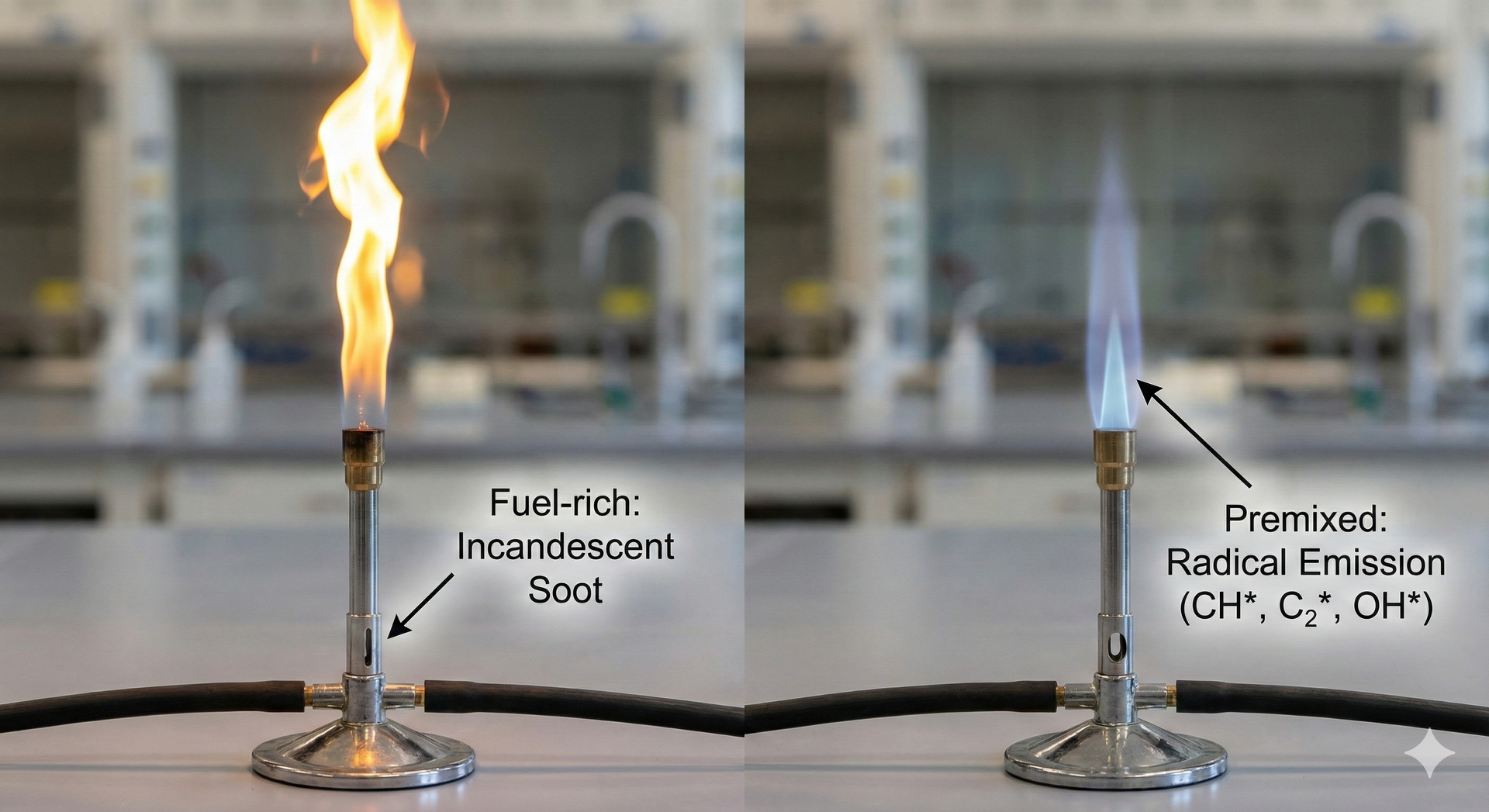
You hay have heard that: blue = efficient combustion, yellow/orange = sooty and inefficient.
That’s roughly right, and the reason is all about oxygen and mixing:
-
Blue flame (e.g. properly adjusted gas stove):
Fuel pre-mixed with enough air → nearly complete combustion → very little soot. Light comes mainly from excited radicals like , , and emitting in the blue/green. -
Yellow/orange flame (e.g. lazy candle, smoky campfire):
Fuel-rich pockets + poor mixing → lots of soot particles form. Those tiny hot carbon particles (maybe ~1500–1800 K) glow like incandescent mini-coals, peaking in the yellow/orange part of the spectrum.
So a yellow flame is basically a cloud of microscopic hot embers suspended in gas. That’s why such flames are:
- More luminous
- Cooler on average
- Sootier and less efficient (carbon leaves as smoke instead of )
4. Where do all the colours actually come from?
There are two main light-making mechanisms in flames:
4.1 Blackbody radiation from soot
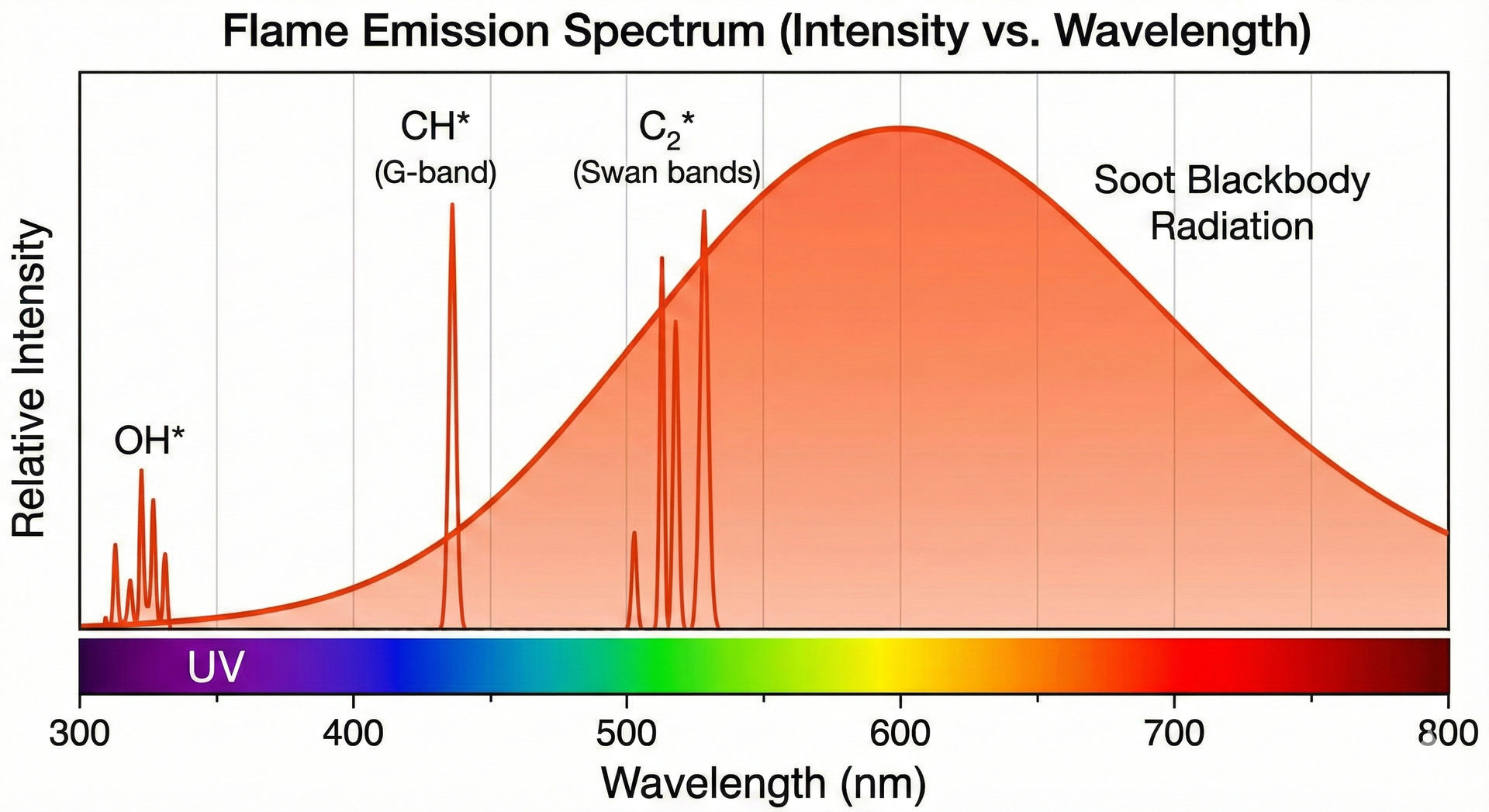
Hot soot particles behave roughly like tiny blackbodies: they emit a smooth, continuous spectrum whose shape depends on their temperature. Think about how a bar of metal when heated would go from black, dull red, orange, yellowy-orange, yellow to white - that's blackbody radiation in action. For temperatures in a wood or candle flame, that spectrum peaks in the red–orange, which is why a sooty flame looks yellow/orange/red overall.
4.2 Electronic + vibrational + rotational transitions in molecules and radicals
Molecules like , , , in excited states (often denoted with a * or by labels like A²Δ, B²Σ) drop to lower energy states by emitting photons at specific wavelengths (lines or bands). For example:
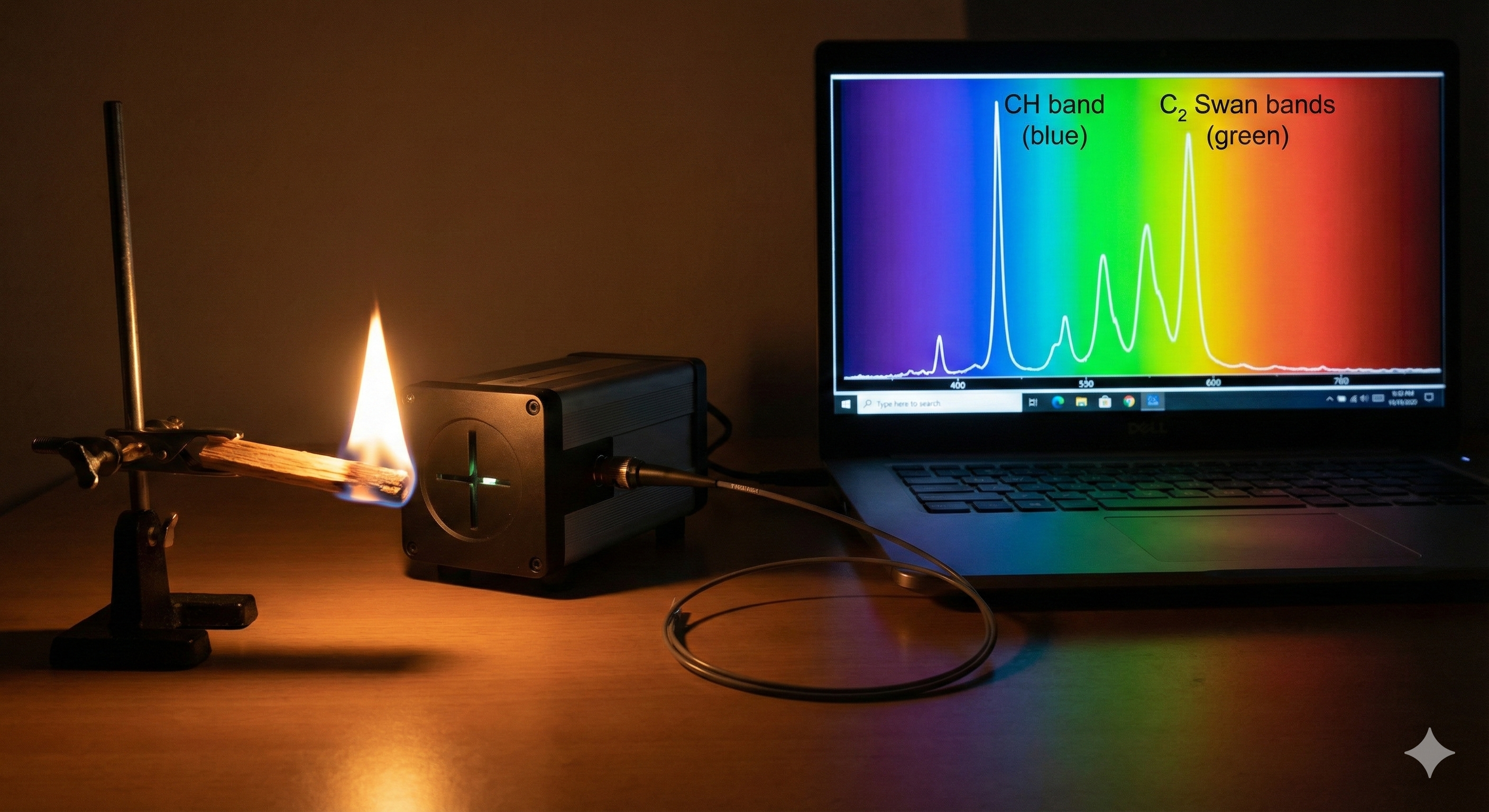
- CH*: strong band around ~430 nm (the famous G-band, blue)
- C₂* (Swan bands): ~510–520 nm (greenish) and other regions
- OH*: ~306–310 nm (mostly UV, but contributes to bluish tint)
- CN*: violet band near ~388 nm
These emissions are overlayed on top of the smooth soot background. In a clean blue flame (little soot), the line/band emission dominates, so the colour is strongly shaped by these radicals.
In labels like or , each piece is telling you something about a specific electronic state of the molecule. The capital letter () is just a name: is the ground electronic state, are higher excited states in order of increasing energy. The superscript “2” is the spin multiplicity (so “2” means a doublet state with one unpaired electron, appropriate for a radical like CH). The Greek letter () tells you the orbital angular momentum about the bond axis: corresponds to , to , to , and so on. For states you sometimes see extra symbols like or , which encode how the electronic wavefunction behaves under reflection in a plane containing the bond axis; here, is one such symmetry type. So, for example, means “an electronic transition from the first excited doublet- state down to the ground doublet- state,” and that’s the backbone electronic jump whose fine rotational/vibrational structure gives you the CH G-band.
5. What’s in a wood flame, spectroscopically speaking?
If you look at a wood flame with a spectrometer, you’ll see features from:
- Major stable products: CO₂, H₂O (strong in IR, weaker structure in visible)
- Radicals: CH, C₂, OH, CN, sometimes NH and others
- Trace metal lines: Na (bright yellow at 589 nm), K, Ca, etc., from minerals in the wood or contaminants
Studies of biomass flames show that the CH, C₂, and OH bands are robust features across different wood species, even though the details vary with moisture content, mixture fraction, and burning phase.
In other words, that flickering wood fire in your living room is doing real molecular spectroscopy all the time - you just don’t usually separate the colours finely enough to notice.
6. Molecules as tiny springy tops: vibrational and rotational modes
To understand those bands (especially the CH G-band), we need one more ingredient: quantized energy levels.
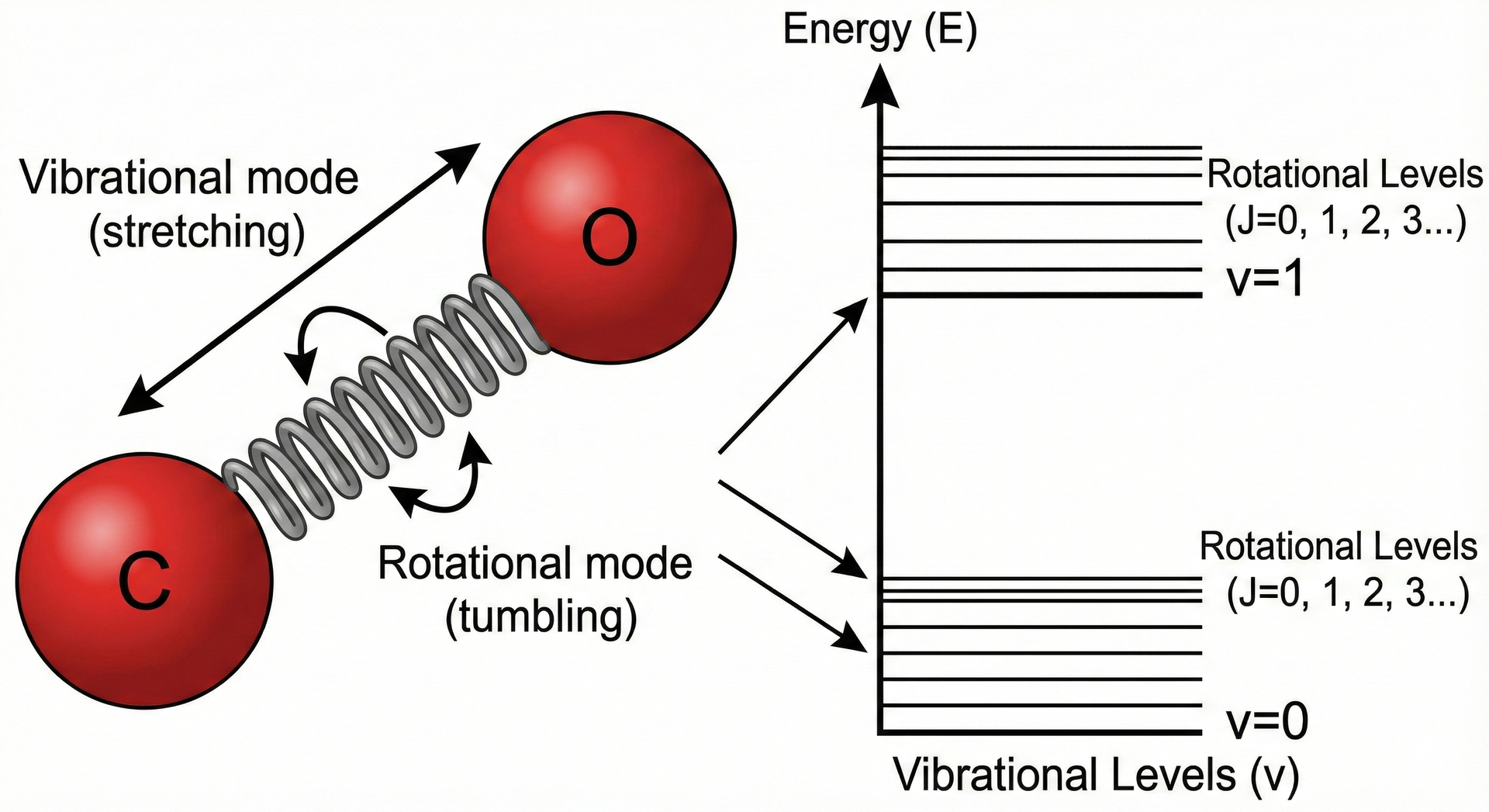
Think of a diatomic molecule like CH or C₂ as:
- Two masses (the atoms) connected by a spring (the chemical bond):
→ they can vibrate: stretch and compress. - A spinning dumbbell:
→ they can rotate.
Both vibration and rotation are quantized:
- Vibrational states labeled by
- Rotational states by
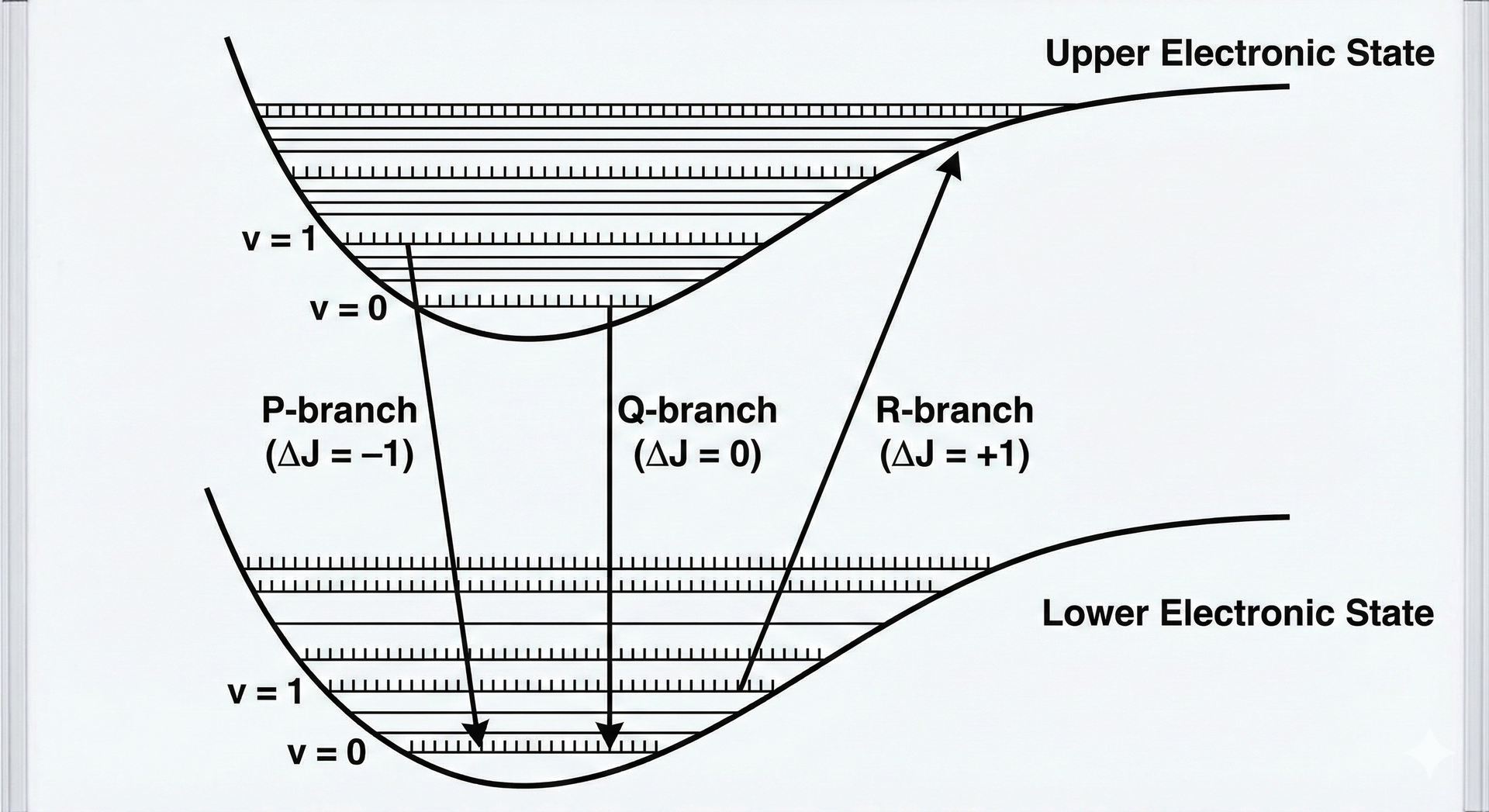
Each electronic state (like X²Π, A²Δ, B²Σ⁻ for CH) has its own ladder of vibrational levels, and each vibrational level has its own stack of rotational levels. When a molecule changes state, it can change all three at once:
Rovibrational spectroscopy is basically the business of decoding which and happened from the pattern of lines you see.
Selection rules (from angular momentum and symmetry considerations) usually give:
- P branch (lines to longer wavelength / lower frequency)
- Q branch (cluster near the band centre)
- R branch (lines to shorter wavelength / higher frequency)
So a single electronic–vibrational transition (say, ) often appears as three sub-bands: P, Q, and R.
7. The CH G-band and its P/Q branches
Now to the star of many flame spectra: the CH radical.
When you burn a hydrocarbon in air, CH is produced in the inner blue region of the flame. CH has several electronic states; the most spectroscopically famous are the A²Δ and B²Σ⁻ excited states and the X²Π ground state. Transitions like A²Δ → X²Π and B²Σ⁻ → X²Π give strong emission bands in the near-UV and blue.
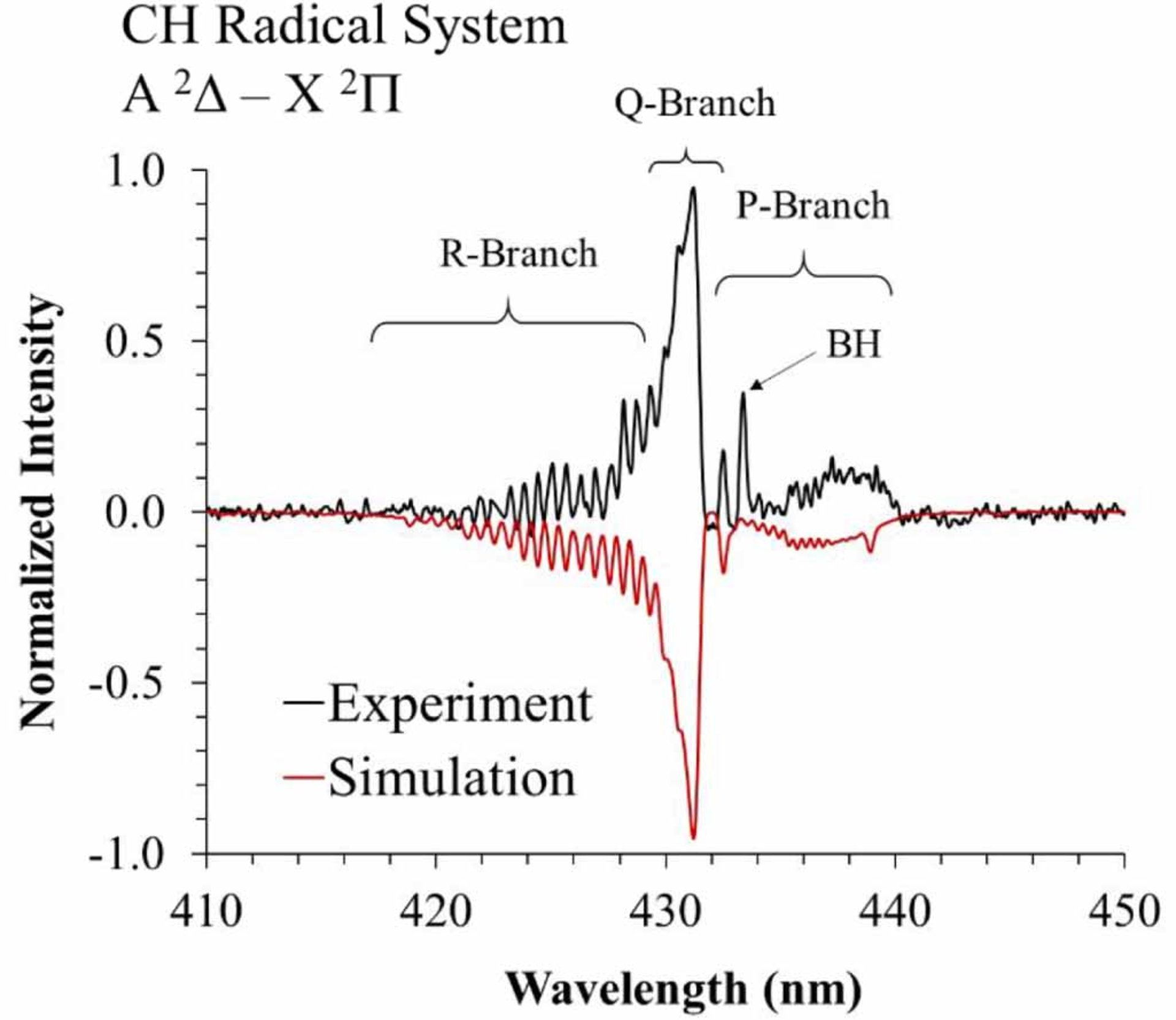
- The “G-band” is the prominent CH band system around 430 nm in the blue.
- At high spectral resolution, the G-band is not a single blur; it’s a forest of narrow rovibrational lines.
Zoom in on one of these bands (say, A–X, ), and you’ll see:
- A dense Q-branch near the band centre () – often appearing as a sharp, intense spike.
- A P-branch () spreading towards longer wavelengths (red side).
- An R-branch () spreading towards shorter wavelengths (blue side), depending on the specific sub-band.
Because the flame is hot (~1500–2300 K in blue regions), many rotational states are populated. The relative intensities of lines across the P/Q branches actually encode the rotational temperature of the CH population, so you can use the G-band as a thermometer if you’re willing to do the line-by-line analysis.
In practical combustion diagnostics, people routinely look at CH* emission at 430 nm as a marker of flame front location and quality of premixing.
8. So… is a flame a plasma?
You’ll sometimes see claims like “fire is plasma.” The careful answer is: sometimes, but only a little, and mostly in very hot or electrically excited flames.
- A plasma is a gas where a significant fraction of particles are ionized (electrons completely ripped and separated from their origin atoms), so charged species (ions + electrons) dominate its behaviour.
- Ordinary air or wood flames at ~1500–2000 K have some ionization (electrons, positive ions like H₃O⁺, NO⁺, and negative ions) but the ionization fraction is tiny (often around or less).
So:
- A candle flame contains a weakly ionized region; you can deflect it slightly with strong electric fields.
- Very hot flames, flames with added alkali salts, or plasma-assisted combustion (nanosecond discharges, etc.) can behave much more like proper plasmas.
But in everyday life, it’s more accurate to think of a flame as hot reacting gas plus radicals and a sprinkle of ions, not as a fully developed plasma like in a neon sign or a lightning bolt.
9. Bringing it back to the log burner
Next time you’re watching a fire:
- The pale blue wisps are where fuel vapours first mix with oxygen and radicals like CH, C₂, and OH light up.
- The bright yellow tongues above are soot particles glowing as they’re oxidized.
- The glowing coals underneath are char undergoing slow, surface-limited oxidation.
- And hidden in all that, structured bands like the CH G-band quietly encode temperatures and molecular energy levels via their P and Q branches.
- In a clean blue hydrocarbon flame, most of the blue comes from electronic transitions in radicals like CH*, with the fine structure set by their rotational and vibrational modes.
We “know” what fire is. But under the hood, it’s an insanely dense packet of fluid dynamics, radical chemistry, spectroscopy, and even a hint of plasma physics, running live on a bit of wood.